
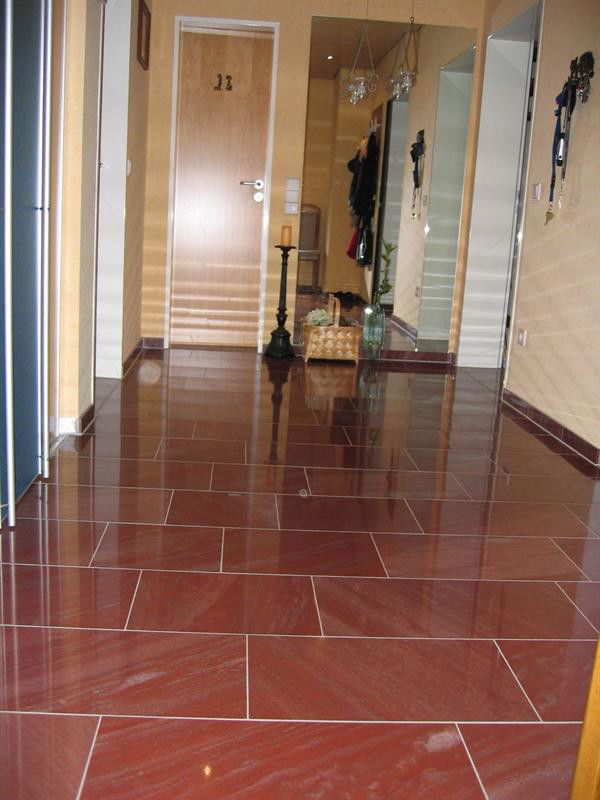
Floor tiles made of Älvdal quartzite polished surface
Floor tiles 10 mm made of Älvdal quartzite polished surface The polished surface is glossy like a water mirror, and due to the hardness of the stone, this extremely beautiful surface stays shiny pretty much forever.
Each tile is completely unique and you get an incredibly beautiful floor.
Choose the number of square metres and go to the checkout to get your total price.
Shipping is added to the prices and is charged separately.
Läs mer
Liknande produkter
Beskrivning av Floor tiles made of Älvdal quartzite polished surface
This unique type of stone is quarried within Vasaloppet’s control station in Mångsbodarna.
The stone is perfectly suited for wherever there are high demands on durability and the where there is a high degree of wear and tear. In entrance areas, hallways, stairs etc. By using different surface finishes and ways to cut the stone, you can obtain a variety of combinations that give the surface an extremely beautiful combination without having to change the type of stone.
Älvdal Quartzite is a sedimentary rock, which means that each stone is a unique structure. This means that shifts in the stone occur, such as stripes, colour with varying tones depending on which surface finish is chosen on the product. WasaSten AB manufactures countertops, ground slabs, window sills, floor tiles, stone stairs, paving stones, stoves, bollards and bathroom counters. Well-known reference objects are Alviks Torg, Högdalens Centrum, the Pk-house / Nordea next to the royal garden, the SIF-house, Millesgården in Stockholm.
History:
Dalarna was a sandy coast about 1,400 million years ago. The sand was carried there by the waves and formed deposits on the bottom of the sea. Deposits that now appear as a beautiful sediment structure in the stone. Heavy rain showers fell over the area and it was very hot. Iron was conveyed into the sea and oxidised there - of which the reddish colour of the Älvdal quartzite offers not the least evidence. Because that's where the Älvdal Quartz site was born. If you visit the quarry you can see how the stripes in the stone run at different angles. This is due to how the seabed sloped when the stone was formed.
Due to the abundant amount of quartz, the Älvdal quartzite is a very hard and difficult-to-work material - but the advantage is, of course, that the finished result is extremely durable. It is important to think carefully during the summer months when you break off the blocks. It takes decades of experience to know how you should do. Almost next to surgical precision, the incisions are laid to get the blocks out so that the lines run smoothly. "You just have to read the stone correctly," said the head of the quarry as he looked over it on a warm May morning. So simple.
And it is just as easy to then saw the stone. To get exactly the right angle on the stripes, the block is stacked with millimetre precision at the saw. To cut up the hard Älvdal quartzite, large diamond blades and computer-aided control systems are required. It is a strange experience to go to Mångbodarna and there, at the end of a dirt road in the middle of the forest, find a high-tech industrial production of the highest class.
At the same time. Every slab made at the production line is carefully checked by hand. Every product is examined by experienced eyes. The quality seal that you find on the packaging is as much an expression of pride in professional skill as a guarantee.
But everything is not done industrially. The artisan lives within each of us, and in some of our products we get an outlet for that joy. Hear the whistling sound that occurs when the stone is split using the traditional tools. See how the machined surface comes forth. Feel the shift where the wedge is to be put.
Sense Morality: Technology can only facilitate and provide support - never replace - human craft and know-how.
That is the story of Älvdal quartzite.